Intent
Our art curriculum introduces children to a variety of media, vocabulary and artists. Children are provided with a range of opportunities to build and revisit their skills and knowledge through which they will develop their confidence, resilience and competence as individual artists.
The breadth of our art curriculum, is designed with three goals in mind:
- To provide appropriate experiences to develop as confident, responsible citizens;
- To provide a rich ‘cultural capital’;
- To provide a coherent, structured art curriculum that leads to sustained mastery for all and a greater depth of understanding for those who are capable.
Our Values in Art
At Market Drayton Infant School, we are committed to providing our children with inclusive and enriching creative opportunities through our Art & Design curriculum and beyond. This links closely with our school values.
Collaboration
|
Respect
|
Aspirations
|
Positivity
|
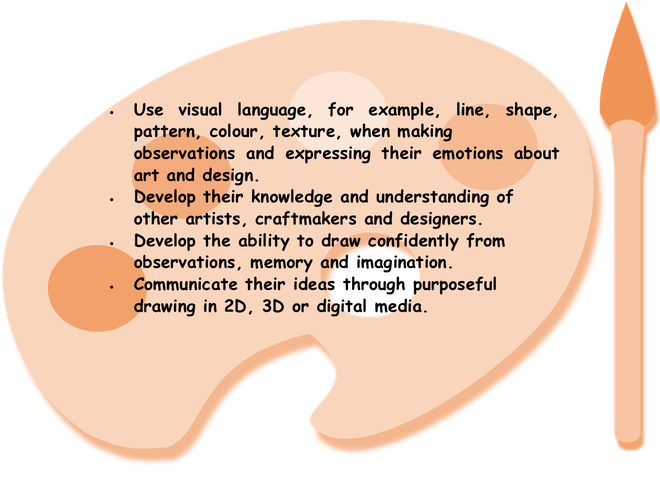
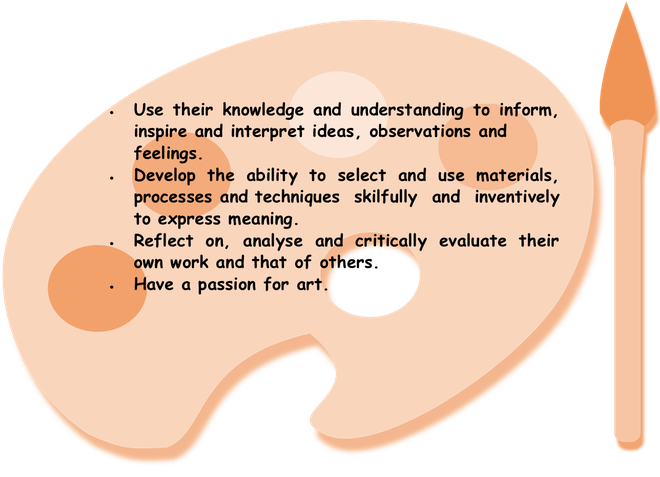
As Artists we want children to:
Implementation
How Do We Deliver the Art Curriculum?
Our Art and Design Curriculum is based on the Chris Quigley Essentials curriculum and threshold concepts. Through our three clear threshold concepts children will experience and become immersed in a deepened understanding of artistic aspects.
The ‘threshold concepts’ are what pupils should understand and the skills they should develop. In Art and Design, these are returned to again and again across all year groups, they are what develops us as artists. These include:
- Develop ideas
- Take inspiration from the greats
Master techniques
This returning to the same thing again and again is called interleaving. A detailed progression can be found in the document below.
Art in the Early Years
Our children begin their journey as artists in the early years, where they are immersed in a creative, explorative environment and given the confidence to develop self-expression within expressive arts & design. Having been exposed to an environment rich in different materials, colours, patterns, textures and tools, our youngest artists begin to develop their own ideas and select how they would like to express them. Children develop their artistic and cultural awareness that helps to build firm foundations for the next stage of education in KS1.
Each pupil has their own sketchbook that remains with them as they move up through the school. This display of their developing ideas and techniques further allows them to reflect on their artistic progress and revisit prior learning. Children’s work outside of their sketchbooks, as well as further observations to capture pupil voice (including photographs) are displayed within the class floor book.
Art in Key Stage One and beyond
In KS1 (Years 1 and 2) children are encouraged to make links between their learning within a current, or previous blocks, e.g. the children may use the skills and techniques developed when working with a particular material (such as clay) within the different cycles. For example in cycle 1, children encounter this material during their work on Vincent Van Gogh, and then again in cycle 2 when studying Clarice Cliff. Safe and correct use of equipment is frequently addressed within lessons. Beyond discrete lessons, children are provided with the wider opportunities such as artist workshops and local competitions to explore their individual artistic talents.
Year 1 and Year 2 cover the same threshold concepts but at different levels. We expect Year 1 to achieve a basic level of these concepts by the end of Year 1. We expect all children to be at an advanced level by the end of Year 2 with many reaching a deep level of understanding. As they progress into KS2 (Year 3-6), children will build on the skills and knowledge covered in KS1 to continue their journey as artists.
The Learning Pathway below gives you a really good overview of our art curriculum from nursery to Year 6.
This planning overview details what we learn in Art in Key Stage 1.
| Year 1 and 2 Planning Overview | ||
| Cycle A | Van Gogh
Observations, tints and tones, sculpture, sketching, painting |
Henri Rousseau
Tropical Storm Painting, taking inspirations, watercolour, sculpting using a variety of materials |
| Cycle B | Yayoi Kusama
Take inspiration from the greats, observational drawing, exploring shadows and shading, tints and tones, colour mixing |
Clarice Cliff
Women’s role in ceramics, pattern, sculpture |
Special Educational Needs and Art
How do we ensure all children can access art lessons?
Our art curriculum celebrates the inclusion of all pupils including those with special education needs and disabilities, ensuring that all children can reach for the stars. Whatever a child’s prior attainment, teaching sets out high expectations and ambitious targets to allow each child to realise their creative potential. Any potential barriers to learning should be identified and subsequently, lessons should be planned to address these areas of difficulty to inspire pupil achievement.
Challenge and support specific to art may include:
- Pre-teaching of key vocabulary, concepts and processes
- Adapted materials or tools (For example, to support children with difficulties in fine motor control)
- Use of the pupil knowledge organisers (Shared with parents/carers prior to teaching)
- Accessible and engaging visual displays (reducing reliance on memory/cognitive load)
- Multi-sensory approaches
- Smaller steps
- Pupils not secure within a lesson sequence are noted and adjustments made to the differentiation or level of support given.
- Similarly, added challenge is given if pupils are identified as requiring it. Using an ‘interleaving’ approach means that pupils continually revisit their learning, gradually building a deeper understanding.
Links to other subjects
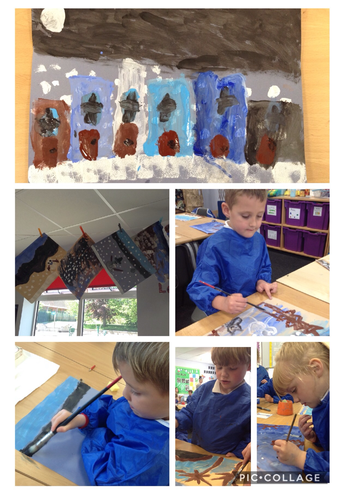
To raise children’s aspirations as artists, we always look for opportunities beyond the classroom.
Annually, all children have the opportunity to take part in a community calendar competition. We are very fortunate to have local practitioners that visit the school and demonstrate wider creative opportunities beyond the classroom; upholding the notion that Art & Design plays an integral role both within the classroom and society.
Home Learning
Below are links to websites and activities that you may wish to share at home.
Learn to Draw with Disney – Use this Youtube series to draw some of your favourite characters!
Explore the Louvre – Use this link to explore art at the Louvre!
Explore the Tate – Check out the Tate museum.
Art Activities – Here is some art inspiration for you to try at home!
Working with the Community
To raise children’s aspirations as artists, we always look for opportunities beyond the classroom.
Annually, all children have the opportunity to take part in a community calendar competition. We are very fortunate to have local practitioners that visit the school and demonstrate wider creative opportunities beyond the classroom; upholding the notion that Art & Design plays an integral role both within the classroom and society.
Impact
How Do We Help Children Get to a Deep Level of Understanding?
Through the explicit teaching of skills in Art and Design, both the teachers and the pupils assess their learning continuously throughout the lesson. To help children get to a deep level of understanding we return to the threshold concepts again and again.
Children develop each concept over time and it takes a two-year period to get to a deeper level of understanding at the appropriate age. For example, in year 1, children will have a basic understanding of art and design at an age appropriate level, but by revisiting this they should have a deeper level of understanding and have developed their skills by Year 2. Progression in their work as artists is shown in their sketch books.