Intent
Our Music Curriculum design is based on Chris Quigley Essentials Curriculum linked to the Model Music Curriculum. Our curriculum design is based on evidence from cognitive science; three main principles underpin it:
Learning is most effective with spaced repetition.
Interleaving helps pupils to discriminate between topics and aids long-term retention.
Retrieval of previously learned content is frequent and regular, which increases both storage and retrieval strength.
In addition to the three principles we also understand that learning is invisible in the short term and that sustained mastery takes time.
Our Values in Music
Collaboration |
Respect |
|
|
Aspirations |
Positivity |
|
|
In Music we want the children to:

Implementation – How Do We Deliver the Music Curriculum?
Curriculum breadth
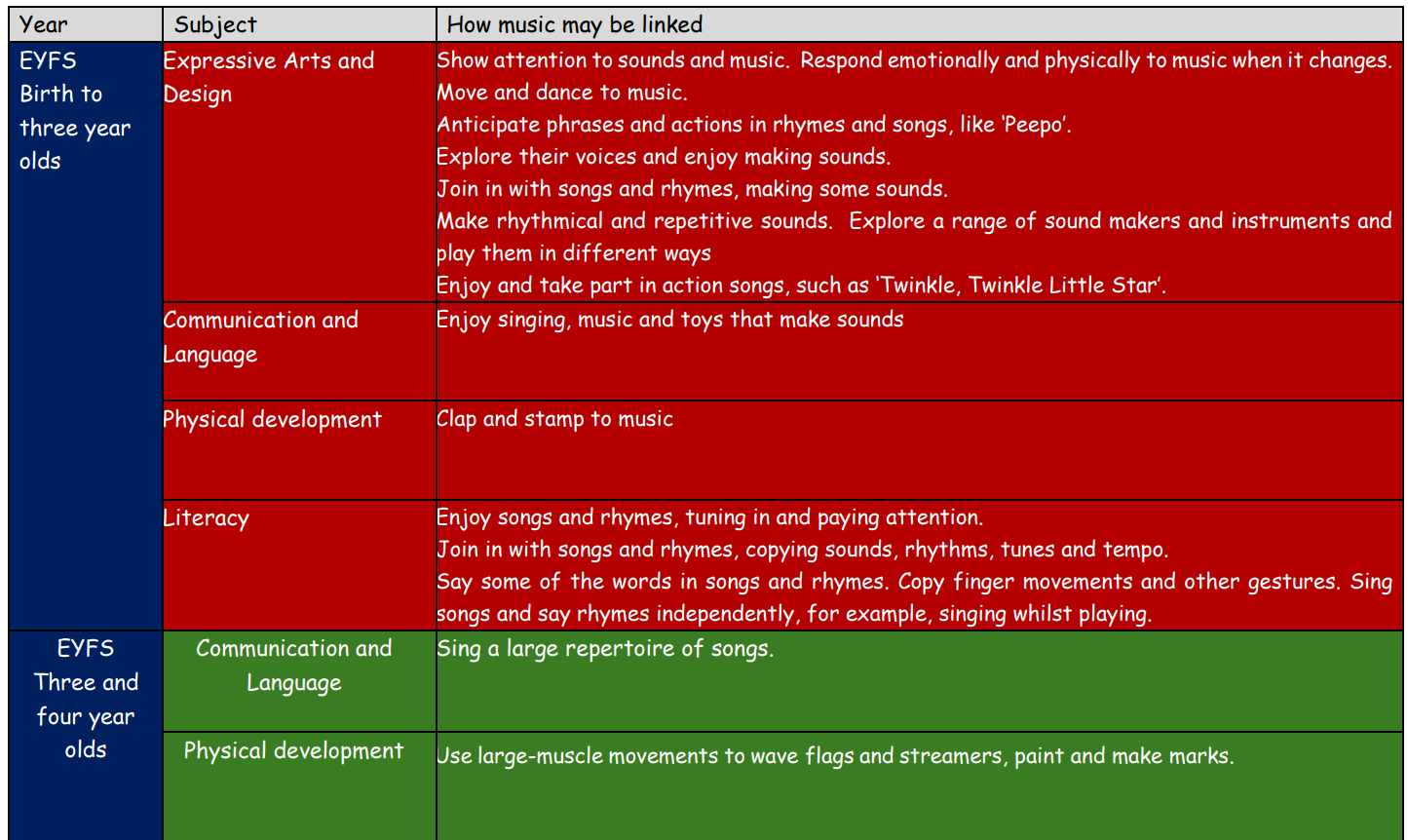
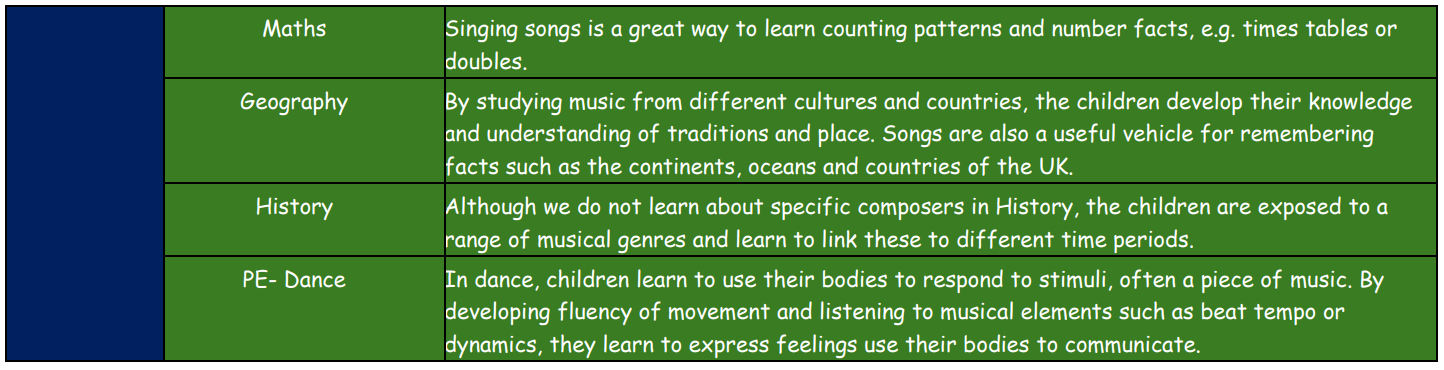
Music is taught as a discrete subject but also across the curriculum. Areas of learning, such as times tables in maths, vocabulary in languages and movement in dance can all incorporate different elements of music. A weekly Year group singing assembly allows the children opportunities to develop their singing skills and gain an understanding of how ensembles work. Performances, such as Christmas nativities, assemblies and end of year shows, demonstrate that music is important to the life of the school. Through our singing and listening we cover a wide range of musical genres which the children will revisit throughout their time in school.
Early Year Foundation stage
Music in the Foundation Stage (Nursery to Reception) is an integral part of daily activities. Routines and concepts are regularly taught through song, opportunities to explore and play instruments are provided, both outside and inside in continuous provision, and specific vocabulary and musical concepts are taught throughout the year as part of topic work. We relate the musical aspects of the children’s work to the objectives set out in the Early Learning Goals (ELGs) which underpin the curriculum planning for children aged nought to five. Music makes a significant contribution to the objective in the ELGs of developing a child’s skills and understanding of Expressive Arts and Design but has many cross curricular links, e.g. with physical development and communication.
Key Stage 1: Years 1 and 2
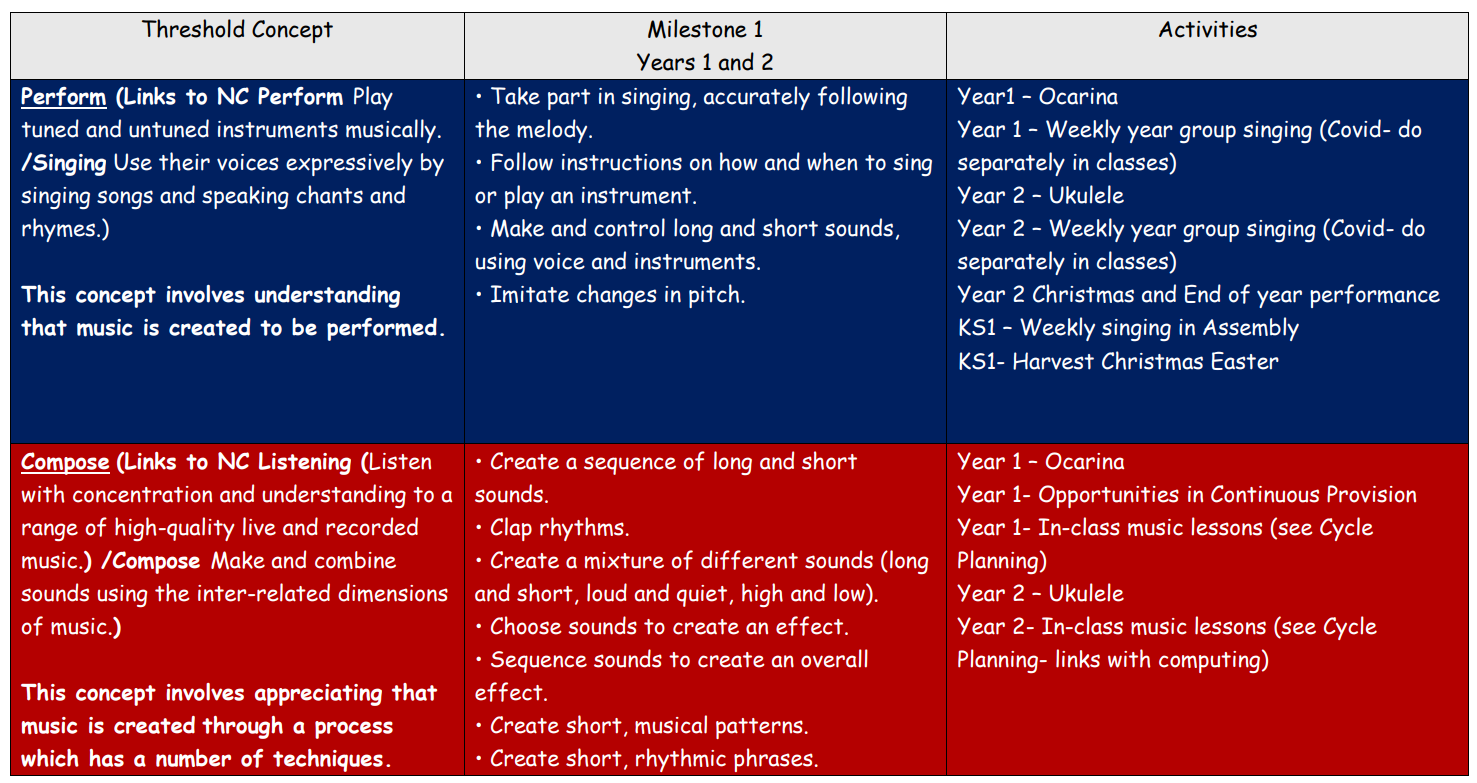
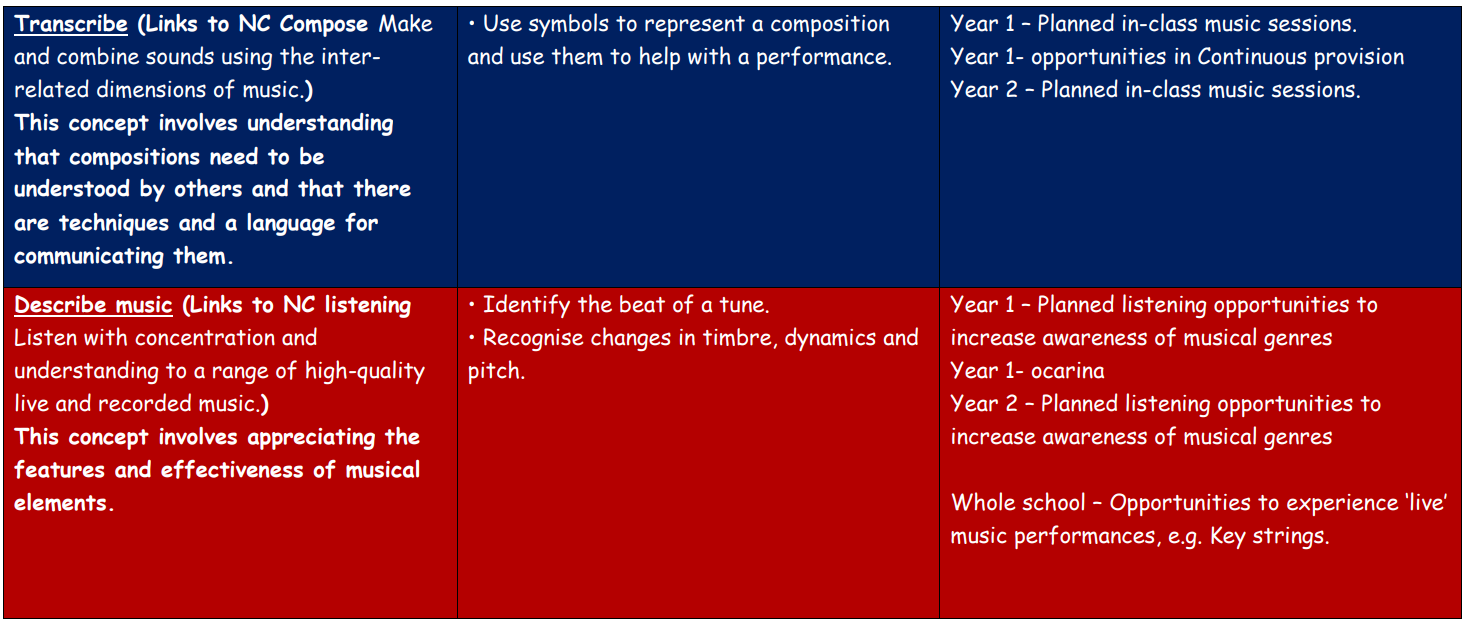
The breadth of the curriculum links in with the programmes of study from the national curriculum. In Key Stage 1, the Model Curriculum provides a separate programme of study for Year 1 and 2, which we use to help us plan listening, singing, performing and composing opportunities. As part of the local curriculum and to keep with the idea of ‘possibilities’ the school offers a broader music curriculum than the national curriculum. Across the key stage, children are taught a tuned instrument; in Year 1 this is the ocarina and in Year 2, the ukulele. This valuable experience also teaches the children how to read simple notation, as well as the musicianship skills and techniques required to play an instrument. This increased understanding of what a musician does and the opportunities to learn a new skill all add to ‘cultural capital’.
Threshold Concepts– In Key Stage One the Chris Quigley Threshold Concepts of Perform, Compose, Transcribe and Describe are taught and revisited throughout the two years.
Music Activity throughout the School
Music Vocabulary throughout the School
Special Educational Needs and Music
Music has a rare and unique ability to bring people together; music making can make a whole class, school and community feel connected to others and part of something bigger. Our music curriculum celebrates the inclusion of all pupils including those with special educational needs and disabilities, ensuring that all children can reach their creative potential. The National Curriculum Inclusion Statement states that teachers should set high expectations for every pupil, whatever their prior attainment. Teachers should use appropriate assessment to set targets which are deliberately ambitious. Potential areas of difficulty should be identified and addressed at the outset. Lessons should be planned to address potential areas of difficulty and to remove barriers to pupil achievement.
What our Pupils have to say
[lwp_image_carousel gallery_ids=”28999,29000,29001,29002,29003,29004″ _builder_version=”4.27.4″ _module_preset=”default” animation_style=”slide” global_colors_info=”{}” theme_builder_area=”post_content”][/lwp_image_carousel]
Links to other subjects

Impact – How Do We Help Children Get to a Deep Level of Understanding?
To help children get to a deep level of understanding about music we introduce them to a range of musical genres throughout their school careers from Nursery 1 to Year 2. Through discussion, practical hands-on exploration and taught sessions, the children are gradually introduced to the elements of music.
Through both the EYFS curriculum and the Threshold Concepts, the children review and build upon knowledge each time they revisit a concept. At times during the year, quizzes are used to review and encourage discussion. The frequent listening opportunities allow children to compare and contrast genres as their growing musical vocabularies develop. The experience of learning a tuned instrument is invaluable in the pursuance of deep understanding. Children develop learning skills such as perseverance and resilience whilst mastering the basic techniques.
As most of our work in music is practical, we use floor books and videos to record.
Here is our Music Development Plan